
This date is one of four particularly tragic dates in Jewish history, associated with the destruction of the country, Jerusalem, the Temple, and the exile of the Jewish people. It is a day of fasting and prayer.
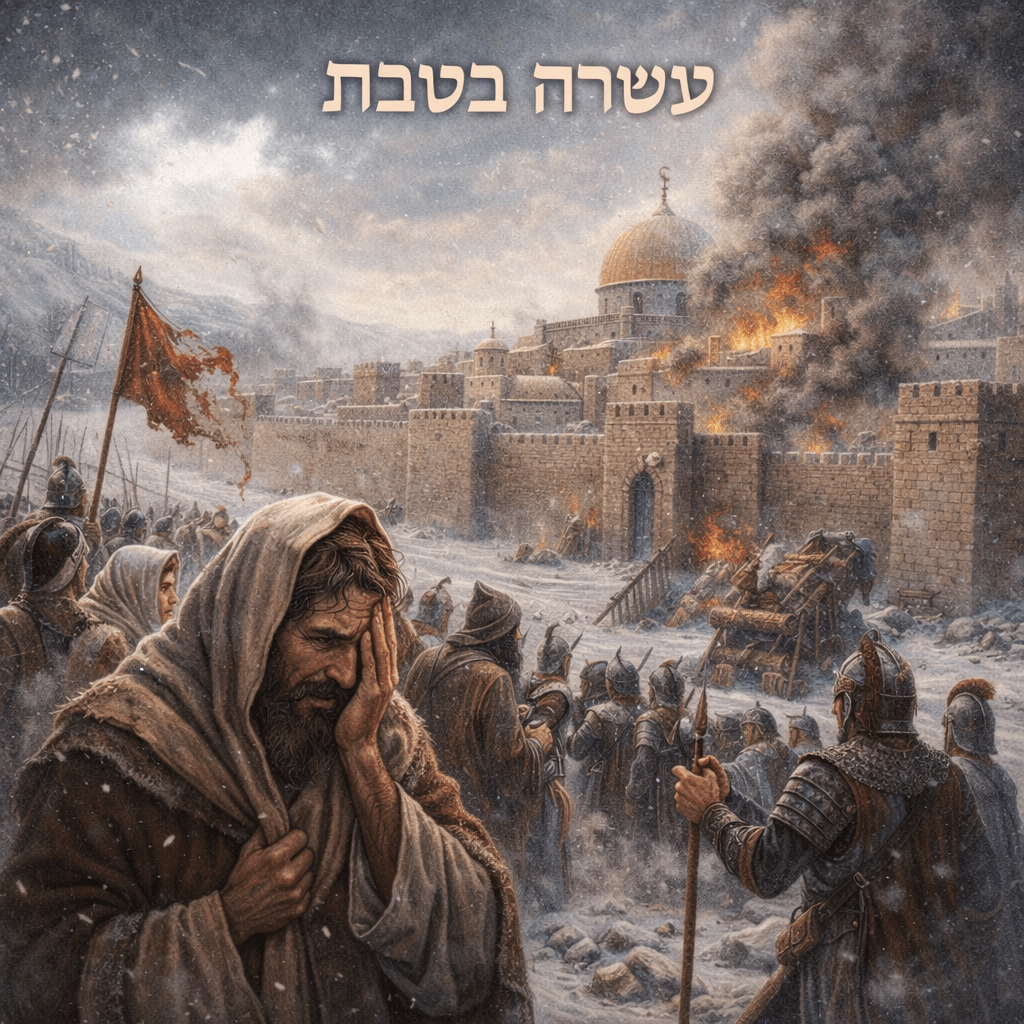
The tenth day of the month of Tevet marks the beginning of the siege of Jerusalem by the Babylonian king Nebuchadnezzar in 3336 according to the Jewish calendar, or 424 BCE. This tragic event occurred after 850 years of Jewish settlement in their land. The fast begins approximately two hours before sunrise and ends in the evening with the appearance of the stars.
It should be noted that in the chronology of particularly tragic events, the 10th of Tevet is the first, followed by the 17th of Tammuz, the 9th of Av, and the Fast of Gedaliah.
The Tanakh says: “And it came to pass in the ninth year of the reign (Tzidkiyahu) in the tenth month (Teveth),” on the tenth day of the month, Nebuchadnezzar, the king of Babylon, came with all his army to Jerusalem and encamped near it, and built a siege rampart around it. And the city fell under siege until the eleventh year of the reign of King Zitzkiah…" (II Kings 2:25).
In the morning shacharit prayer on the 10th of Tevet, as on other fast days, we recite selichot—a special prayer intended for this fast. On this day, as on other fast days, synagogues read from the Torah how Moshe Rabbeinu prayed for all the people, begging the Almighty to forgive the Jews for the sin of building the golden calf. And the Jews hope to receive from the Almighty a response similar to that bestowed upon Moshe Rabbeinu: "I have forgiven, as you asked."
In the evening, in the Mincha prayer, after the Torah reading, we read a passage from the book of the prophet Isaiah: "Seek the Lord when He is approachable, call upon Him when He is near." For the purpose of the fast is preparation for repentance and return to G-d.
In our generation, the generation of the Holocaust and the creation of the State of Israel, the 10th of Tevet has acquired another meaning. Immediately after the establishment of the State of Israel, the Chief Rabbinate decreed that this day would be the Day of Kaddish—a day of remembrance for the victims of the Holocaust whose date of death is unknown. Many of the six million Jews died a cruel, painful death, and the date of their death is unknown because there were no witnesses to their deaths. On the 10th of Tevet, a ner neshama (memorial candle) is lit, Kaddish is said, and the Mishnayot is taught in the name of the souls of these martyrs.
The former Chief Rabbi of Israel, Rabbi Israel Meir Lau, writes in his book "The Practice of Judaism" that great symbolism lies in the connection between these two tragic events—the beginning of the destruction of the First Temple and the attempt to completely destroy the House of Israel in our generation.
In this On this day, we express our hope that the Holocaust of European Jewry brings to an end a terrible era in the history of the Jewish people that began with the destruction of the First Temple. We express our hope that the words of the prophet Zechariah will come true and that the days of fasting will turn into days of joy and gladness, into days of celebration. We pray that this prophecy will be fulfilled in our day.