
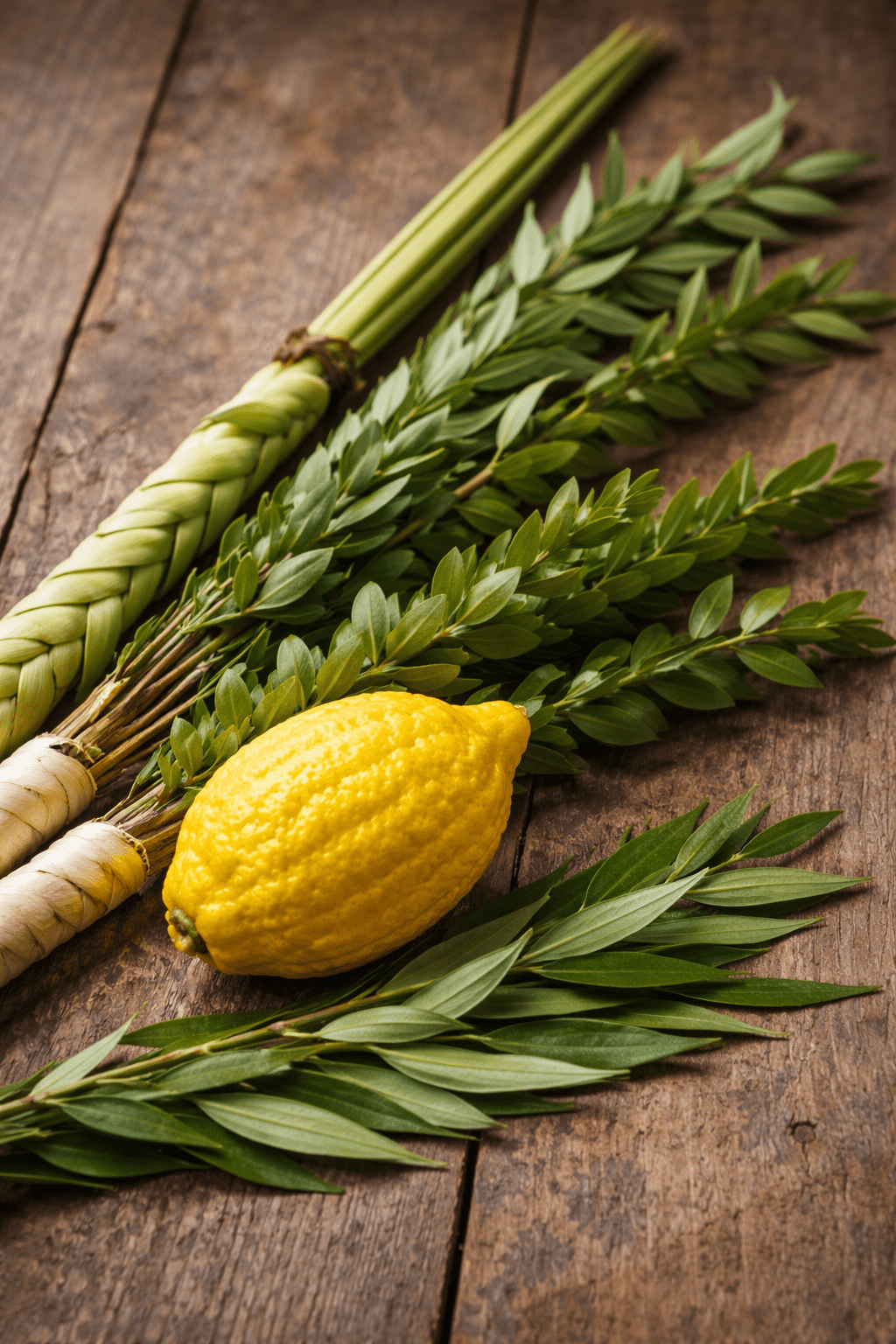

The four species of plants (lulav, etrog, hadasim, and aravot) used to fulfill a special mitzvah on the holiday of Sukkot.
The symbolism of the holiday's mitzvah of the four species of plants is very instructive. These refer to four species of plants native to the Land of Israel. According to the sages, the etrog (a type of citrus fruit similar to a lemon), with its pleasant taste and aroma, symbolizes that portion of the Jewish people who have learned the Torah and perform good deeds. The myrtle, with its pleasant aroma but lacking flavor, symbolizes those Jews who perform good deeds but are not Torah scholars. The lulav, a palm branch whose fruit is pleasant to the taste, symbolizes Torah scholars who do not engage in practical matters. Willow branches, which have neither a distinctive taste nor a distinctive smell, symbolize those Jews who are not distinguished by their knowledge of Torah or great deeds. Concerning these strata of the Jewish people, the Torah says: "They shall not be lost, but bind them together in a single bundle, that they may atone for one another" (Vayikra Rabbah).
Thus, even among those sons of Israel who are not distinguished by their knowledge of Torah or good deeds, the holiness of Israel prevails by virtue of their very nature and historical origin. They are not separated from the rest of the people; rather, in unity with its other groups, they ennoble the Jewish people.